
Best Note-Taking Methods for Learning and Exam Success
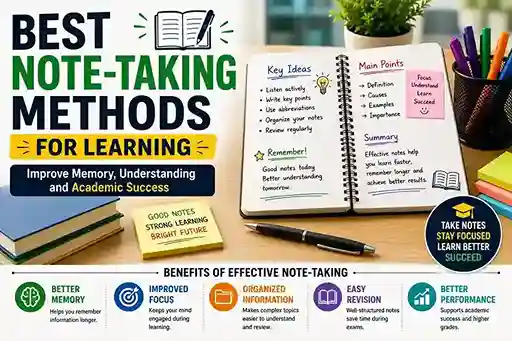
Best Note-Taking Methods for Learning: Improve Understanding, Memory, and Academic Performance
Introduction
Taking notes is one of the most important study skills students can develop. Whether you're in secondary school, college, university, or preparing for professional examinations, effective note-taking can significantly improve your ability to understand, remember, and apply information.
Many students attend classes, read textbooks, and watch educational videos without taking proper notes. As a result, they often struggle to recall important information during assignments, tests, and examinations. Good notes help organize ideas, improve concentration, and make revision more effective.
However, not all note-taking methods work equally well for everyone. Some techniques are better suited for visual learners, while others help students process large amounts of information quickly.
This guide explores the best note-taking methods for learning, their benefits, and how students can choose the right approach to maximize academic success.
Why Note-Taking Matters
Effective note-taking is more than simply writing down information.
It helps students:
- Improve concentration during lessons
- Understand concepts more clearly
- Retain information longer
- Organize ideas effectively
- Prepare for examinations
- Identify key points and important details
Research shows that actively engaging with information through note-taking improves learning and memory retention.
Characteristics of Effective Notes
Good notes should be:
Clear
Information should be easy to read and understand.
Organized
Ideas should be arranged logically.
Concise
Avoid writing every word. Focus on key points.
Accurate
Ensure information is correct and complete.
Easy to Review
Notes should support efficient revision and exam preparation.
The Cornell Note-Taking Method
The Cornell Method is one of the most popular note-taking systems used by students worldwide.
It divides a page into three sections:
Cue Column
Used for keywords, questions, and important concepts.
Notes Section
Contains detailed lesson notes.
Summary Section
Provides a brief overview of the main ideas.
Benefits
- Encourages active learning
- Improves organization
- Simplifies revision
- Supports long-term retention
The Cornell Method is especially useful for lecture-based learning.
The Outline Method
The Outline Method organizes information using headings, subheadings, and bullet points.
Example:
Main Topic
- Subtopic
- Supporting detail
- Supporting detail
Benefits
- Easy to organize
- Suitable for structured subjects
- Makes reviewing information simple
- Highlights relationships between ideas
This method works well for history, science, business studies, and other content-heavy subjects.
The Mapping Method
The Mapping Method uses diagrams to show relationships between ideas.
Students place the main topic in the center and connect related concepts using branches.
Benefits
- Encourages visual learning
- Shows connections between topics
- Improves understanding
- Supports creative thinking
This method is particularly effective for brainstorming and complex subjects.
The Charting Method
The Charting Method organizes information into tables and columns.
Example:
TopicDefinitionExamplePhotosynthesisFood production processPlants
Benefits
- Easy comparison of information
- Ideal for factual subjects
- Helps identify patterns
This method is useful for science, geography, economics, and business studies.
The Sentence Method
The Sentence Method involves writing each new piece of information as a separate sentence.
Example:
- Photosynthesis occurs in plant leaves.
- Chlorophyll absorbs sunlight.
- Oxygen is released during the process.
Benefits
- Simple and quick
- Suitable for fast-paced lectures
- Easy for beginners
However, notes may require additional organization later.
Mind Mapping
Mind mapping is a visual note-taking technique that uses diagrams, colors, and branches.
A central topic is placed in the middle of the page, with related concepts branching outward.
Benefits
- Encourages creativity
- Enhances memory
- Supports visual learners
- Makes revision enjoyable
Mind maps are especially useful for summarizing large topics before examinations.
The Flow Note-Taking Method
Flow notes focus on understanding rather than copying information.
Students connect ideas using arrows, diagrams, sketches, and brief explanations.
Benefits
- Encourages active thinking
- Improves comprehension
- Helps identify relationships between concepts
This method is effective for conceptual subjects and critical thinking tasks.
Digital Note-Taking
Technology has introduced new ways to take notes.
Students can use:
- Laptops
- Tablets
- Smartphones
- Note-taking applications
Popular digital note-taking tools include:
- Microsoft OneNote
- Google Keep
- Notion
- Evernote
Advantages
- Easy organization
- Searchable content
- Cloud storage
- Multimedia integration
Digital notes can include images, audio recordings, videos, and hyperlinks.
Handwritten vs Digital Notes
Many students wonder whether handwriting or typing is better.
Handwritten Notes
Advantages:
- Improves memory retention
- Encourages information processing
- Reduces distractions
Digital Notes
Advantages:
- Faster note-taking
- Easy editing
- Convenient storage
The best option often depends on individual learning preferences.
How to Take Better Notes During Class
Prepare Before Class
Review previous lessons and learning objectives.
Focus on Key Ideas
Avoid trying to write every word spoken by the teacher.
Use Abbreviations
Develop shorthand techniques to save time.
Examples:
- Info = Information
- Ex = Example
- Govt = Government
Highlight Important Points
Use colors, symbols, or underlining to emphasize key concepts.
Ask Questions
Record areas requiring clarification for later review.
Organizing Your Notes
Well-organized notes improve learning efficiency.
Use Clear Headings
Separate topics clearly.
Number Key Points
This improves structure and readability.
Date Your Notes
This helps track learning progress.
Keep Subjects Separate
Use different notebooks or folders for different subjects.
Organization saves time during revision.
Reviewing Notes Effectively
Taking notes alone is not enough.
Students should review notes regularly.
Review Within 24 Hours
This helps strengthen memory retention.
Summarize Key Concepts
Condense information into shorter summaries.
Test Yourself
Cover sections and recall information from memory.
Use Flashcards
Convert important points into study questions.
Regular review transforms notes into long-term knowledge.
Common Note-Taking Mistakes
Writing Everything Down
Attempting to record every word often reduces understanding.
Poor Organization
Disorganized notes can become difficult to review.
Never Reviewing Notes
Information is quickly forgotten without revision.
Ignoring Key Concepts
Focus on understanding major ideas rather than copying details.
Overusing Highlighters
Too much highlighting reduces effectiveness.
Avoiding these mistakes can improve learning outcomes significantly.
Choosing the Best Note-Taking Method
There is no single perfect note-taking system.
Students should choose based on:
Learning Style
Visual learners may prefer mind maps and diagrams.
Subject Matter
Different subjects require different approaches.
Class Format
Lectures may favor Cornell notes, while discussions may benefit from flow notes.
Personal Preference
The most effective method is often the one a student consistently uses.
Experimenting with multiple techniques can help identify the best fit.
Technology and the Future of Note-Taking
Modern technology continues to transform note-taking.
Emerging trends include:
- AI-powered note-taking tools
- Automatic lecture transcription
- Smart study apps
- Voice-to-text systems
These innovations help students capture information more efficiently while improving accessibility.
Conclusion
Effective note-taking is one of the most valuable skills students can develop. It improves concentration, strengthens memory, enhances understanding, and supports academic success. Whether you prefer the Cornell Method, mind mapping, outlining, charting, or digital note-taking, the key is finding a system that matches your learning style and educational needs.
Remember that note-taking is not simply about recording information—it is about actively engaging with what you learn. When combined with regular review and effective study habits, good notes can become a powerful tool for achieving better academic results.
By practicing these note-taking methods consistently, students can improve learning efficiency, perform better in examinations, and build skills that will benefit them throughout their educational journey and beyond.

About the Author:
Femi Victor(Techland Dynamic) is an experienced EdTech consultant and web developer with over 10 years of experience in creating digital learning tools for Nigerian schools. He is passionate about simplifying complex educational data and helping students navigate the admission process.



Comments
No comments yet.